
Sourcing 30 Passive Candidates per Week Without a LinkedIn Recruiter Seat
LinkedIn Recruiter Corporate now runs $10,800 per seat per year before overages. Here is how in-house recruiters hit the same sourcing volume using LinkFetch + Claude, for a fraction of the cost.
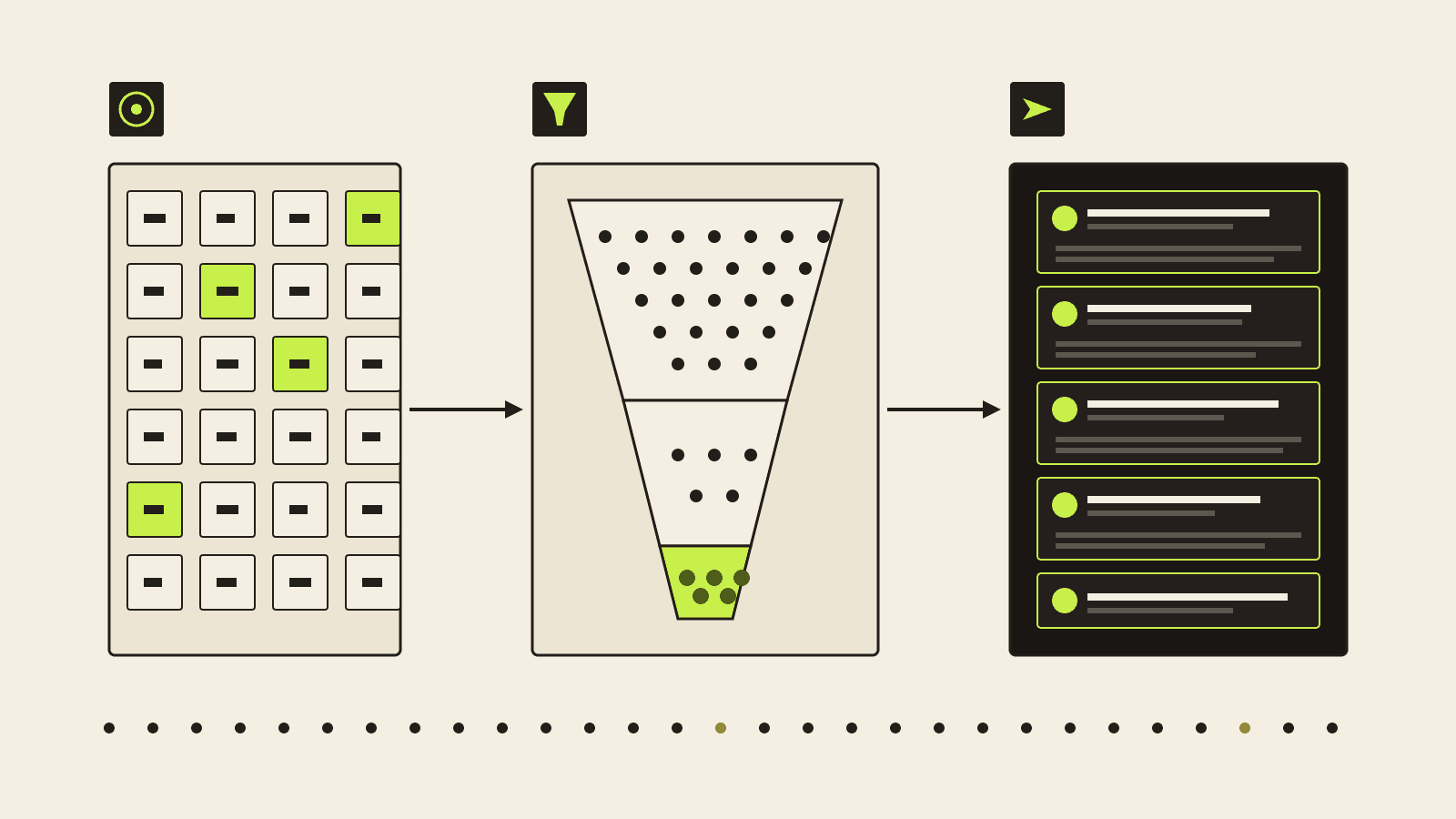
LinkedIn Recruiter Corporate now costs $10,800 per seat per year in 2026, with five-person teams paying $54,000 to $75,000 before InMail overages and add-ons (pin.com, 2026). For a boutique in-house team or a recruiter at a seed-stage company, that is a budget line that competes with headcount. This playbook shows how recruiters using LinkFetch, which connects their own LinkedIn account to Claude, identify and message 30 qualified passive candidates per week, without a Recruiter seat or a single InMail credit.
What a LinkedIn Recruiter seat actually costs in 2026
LinkedIn does not publish a public price list. What it charges depends on company size, contract length, and seat count. Published estimates from broker comparisons and buyer reports converge on a range: Recruiter Lite at $170 per month ($1,680 per year) for a single seat, and Recruiter Corporate at $750 to $1,000 per month ($9,000 to $12,000 per year) with enterprise contracts that can exceed that significantly. The most-cited 2026 single-seat figure is $10,800 per year, and a five-person team will pay $54,000 to $75,000 for LinkedIn alone (pin.com, 2026).
For an in-house recruiter at a 20-person Series A company, a Recruiter Corporate seat is often 10 to 20% of their total compensation budget for the role. The math only works if the seat produces materially better candidate quality or volume than the alternatives. For many recruiters in 2026, it does not. The advanced Boolean search, the team InMail pool, and the ATS integration are real advantages. But the core workflow (identifying passive candidates, writing personalized outreach, and sequencing follow-ups) is now largely reproducible without a Recruiter subscription.
The per-message economics also warrant scrutiny. A Recruiter Corporate seat includes 150 InMail credits per month. At $10,800 per year, that is $72 per InMail credit before you account for the credits that expire unused in slow months. Personalized connection requests followed by direct messages, run through a standard Premium account, see 25 to 35% reply rates and cost nothing per message (salesso.com, 2026). InMail achieves roughly 300% higher response rates than cold email, but the comparison that matters is InMail versus a personalized connection request, and the delta there is much smaller than LinkedIn's marketing materials imply.
The hidden costs nobody quotes you
The $10,800 sticker price is not the real number. Buyer-side analysis of 2026 contracts surfaces a consistent pattern of add-ons that push total cost of ownership 20 to 40% above the subscription price (pin.com, 2026):
- InMail overages. Roughly $10 per credit beyond your monthly allotment. A team that hits its monthly cap halfway through quarter-end pays a four-figure overage in a single month.
- LinkedIn Talent Insights. $6,000 to $20,000 per year as an add-on; not bundled.
- Promoted job posts. $500+ each; the "boost" the algorithm asks you for once you publish.
- Job Slots. $200 to $1,000 per slot per month.
- Annual price increases. Roughly 15% per year on Corporate plans, compounding.
For a small team, the real question is not "is the seat worth $10,800". It's "is the seat worth $14,000 to $18,000 once the add-ons land". On a 5-hire-per-year volume, that's $2,800 to $3,600 of LinkedIn cost per hire, before the recruiter's salary or any other tooling. The unit economics of LinkFetch on your own LinkedIn account plus a Claude subscription run more than an order of magnitude cheaper.
Why passive sourcing is the goal and InMail is the bottleneck
70% of the global workforce is passively open to new roles; 45% of those people will respond to the right recruiter outreach (salesso.com, 2026). The constraint is not access to passive candidates. LinkedIn's basic search surfaces them. The constraint is identifying the right 30 out of 50,000 potential matches, understanding enough about each one to write a message that does not read as templated, and doing that research at a speed that keeps the sourcing loop from consuming the entire work week.
Recruiter seats solve part of this through InMail delivery guarantees and advanced search filters. The part they do not solve is the research and personalization layer. That still requires a recruiter to read profiles, understand career trajectories, and write outreach copy. AI solves that part. The combination of a session-based LinkedIn data API and a language model is a reasonable substitute for the search and delivery advantages a Recruiter seat provides, at a fraction of the cost. AI-powered sourcing reduces sourcing time by over 70% compared to manual Boolean searches in Recruiter (juicebox.ai, 2026), which is the leverage that makes the small-team math work.
The bottleneck in 2026 is not sending messages. It is identifying the moment when a passive candidate is most likely to consider a move. A candidate who just passed a 2-year anniversary at their current employer is more open to a conversation than one who joined 6 months ago. A candidate whose company announced layoffs last quarter has a different receptivity than one at a company that just closed a Series B. These signals exist publicly on LinkedIn; they are just not surfaced by default in standard search results.
The signal-first sourcing model
The workflow starts with a target-profile definition rather than a keyword search. Define the candidate you want in terms of three observable attributes: the role type (current title or closely adjacent titles), the company size band (you want someone with experience at a company large enough to have the problem you're hiring to solve, but not so large that your stage seems like a step down), and a recency signal that suggests openness to a move.
Recency signals worth monitoring:
- 2-year tenure mark at current employer. Career-path data consistently shows elevated openness to move in the 24-to-30-month window of a given role, before someone crosses into deeply established.
- Recent promotion without upward trajectory. A promotion from Senior to Staff, but no VP path visible in the org. Ceiling awareness is a quiet driver of passive job searches.
- Employer restructuring or layoff signal. Publicly announced reductions in force, or a sudden stop in the company's job postings.
- Skills gap at current employer. The company is hiring into roles that suggest the candidate's function is being built out around them, often a sign the original owner of that domain is being positioned for internal transition.
LinkFetch exposes all four of these signal types through its people, company, job, and post tools. get_person returns experience with start dates, which gives tenure and promotion history; get_company and search_jobs show which roles the employer posted in the last 30 days, which surfaces build-out around a function or a hiring stop; search_posts finds public layoff and restructuring announcements. A passive candidate who triggers two or more of these signals is not just theoretically open. They are statistically more likely to respond to the right outreach than the median LinkedIn member.
One practical note on tenure signals: the 24-to-30-month window is an average, not a rule. Engineering roles show higher mobility at 18 to 24 months; senior individual contributors at growth-stage companies tend to stay longer, sometimes through a liquidity event, before they move. Sales roles show elevated mobility after the 12-month mark if a commission structure change has happened. Calibrate the tenure window to the role type and the company stage of your ideal candidate. What the data consistently shows is that tenure alone, without any other signal, is a weak filter. Tenure combined with a ceiling signal (no promotion in 18+ months despite peer promotions) is substantially stronger.
Wiring the workflow: LinkFetch + Claude
The standing prompt runs Monday morning against a refreshed candidate search, producing a queue of personalized connection requests for the week.
Given the following job description and target-profile criteria,
call get_person for each candidate URL in my source list.

For each candidate:
1. Check their experience for tenure at current employer.
   Flag as high-priority if tenure is 18 to 36 months in current role.
2. Call get_company on their current employer.
   Note if it posted few or no jobs in the last 30 days, and use
   search_posts to check for layoff announcements in recent weeks.
3. Write a 3-sentence connection request that:
   - Names one specific thing about their career that is relevant
     to the role I am hiring for (not their headline, not their school)
   - Mentions the company and the specific gap we are hiring to fill
   - Ends with a question, not an ask to apply

Output as a numbered list, one per candidate.
Flag any candidate with 2+ open signals as priority this week.
The prompt produces a complete sourcing queue for the week in approximately 3 to 4 minutes of Claude run time. At 30 candidates per week, this is faster than the time a recruiter would spend reading and summarizing 30 profiles manually, and the output qualtiy, when reviewed before sending, is consistently competitive with what an experienced recruiter writes for top-of-funnel outreach.
The review step matters. AI-generated connection requests that are sent without a human read frequently contain a subtle wrongness in tone (too formal, or referencing something accurate but slightly off in context). A 20-second read-and-tweak per message catches these cases. At 30 messages per week, that is 10 minutes of review for the full queue.
Sequencing without InMail credits
The standard connection-request-to-message sequence outperforms InMail for recruiters with a strong personal brand or a company brand the candidate will recognize. For recruiters at early-stage companies that are not yet well-known, InMail has a minor recognition advantage, but it is not $72 per credit worth of advantage for most roles.
The sequence: send a personalized connection request. (If you send it through LinkFetch, send_invitation goes out without a note and shows a preview before anything is sent, so the personal text moves into your first message after they accept.) If accepted within 48 hours, send a follow-up direct message that adds one piece of new information (a specific detail about the role, a link to a recent company milestone, or a reference to something in their profile you did not mention in the connection note). If not accepted within 5 days, move to email follow-up if you have it, or hold for the next signal event.
Keep 7-day volume to 25 connection requests per day maximum, consistent with LinkedIn's 2026 behavioral guidelines. LinkFetch's own caps are tighter: 20 requests a day and 100 a week per account (10 a day while a new account warms up). At 30 candidates per week, this workflow uses about 30% of that weekly cap and leaves headroom for relationship-maintenance connections and warm introductions. AI use across HR tasks climbed to 43% in 2026, up from 26% in 2024 (herohunt.ai), which means LinkedIn's detection systems are calibrated for AI-assisted workflows. Staying within the published limits is sufficient.
The credit math for this workflow
| Task | Credits used per week |
|---|---|
get_person × 30 candidate profiles |
~150 credits |
get_company × ~20 employer lookups |
~20 credits |
search_posts × ~4 layoff-news searches |
~20 credits |
| Claude composition for 30 connection requests | 0 credits |
| Total | ~190 credits / week |
At LinkFetch's flat per-call pricing, 190 credits per week is just under 10,000 credits a year, which two 5,000-credit packs ($79 each) cover. Against a $10,800 per year Recruiter Corporate seat (or $14,000 to $18,000 once the add-ons land), this workflow covers a full year of sourcing activity for less than three InMail credits' worth at the $72 effective rate.
The break-even question is not cost. It is outcome. A Recruiter Corporate seat with 150 InMail credits and advanced Boolean search can source at higher volume and with better LinkedIn delivery than this workflow. For teams hiring 20+ roles per quarter, the seat probably earns its cost. For in-house recruiters at companies hiring 5 to 8 roles per year, the $10,800 is almost never justified when the alternative is two $79 credit packs a year and a Claude subscription.
The hidden cost of a Recruiter seat that is rarely modeled is the overhead of maintaining it. A seat purchased for a single high-volume hiring sprint and then left at a third of capacity for the rest of the year is still billing at $900 per month. This workflow scales with actual hiring activity: run it intensively when a role is open, stop when it closes, and pay only for the weeks you actively sourced. For companies with lumpy hiring (a burst of 3 to 5 hires at Series A, then quiet for 6 months) the usage-based cost profile is a material advantage over an annual seat contract.
FAQ
Does this work if I do not have a LinkedIn Premium account at all?
The base version works on a standard LinkedIn account, connected once through the LinkFetch Chrome extension. Some features (the ability to see who viewed your profile, extended profile visibility outside your network) require Premium. For sourcing, the meaningful limitation of a non-Premium account is InMail: you cannot send InMail without a paid seat. The connection-request workflow in this playbook is available on any account.
How do I build the initial candidate URL list to feed into the prompt?
LinkedIn's basic search, available on all account tiers, returns profile results you can collect as URLs. Build a Boolean query for your target role and run it weekly, collecting the first 50 to 100 results. Feed those URLs into the workflow as the source list. This is more manual than Recruiter's saved search alerts, but a saved search in LinkedIn's basic interface also updates on a weekly basis for most tiers.
What response rates should I expect?
Personalized connection requests to well-targeted passive candidates see 25 to 35% acceptance rates in 2026 (salesso.com). Of those who accept, 40 to 60% will read a follow-up direct message. That produces 6 to 12 substantive replies per week from a 30-candidate queue, which is a healthy pipeline for most in-house teams. The variance is driven by role type (engineering roles typically see lower acceptance rates than sales and ops), company recognition, and how well the message references something specific.
Can I use this for high-volume agency recruiting?
This playbook is designed for in-house recruiters sourcing 5 to 30 candidates per week per role. Agency recruiters working 10+ concurrent searches at higher volume will hit the connection-request limits and need a different architecture: either multiple accounts (LinkedIn's ToS prohibits this for automation but not for individual recruiter seats), a Recruiter team license, or a workflow that prioritizes email-first sourcing with LinkedIn as a signal layer rather than the delivery channel.
How does LinkFetch handle profiles with restricted visibility?
Some profiles are visible only to first-degree connections or restrict public access via privacy settings. LinkFetch sees the same data your connected LinkedIn account can see. If a profile is not visible to you while browsing LinkedIn, get_person will not return it either. In practice, 5 to 10% of sourced candidates have restricted profiles. Flag these for manual review rather than skipping them. A profile that is deliberately private often belongs to a high-tenure candidate who is precisely the passive-open profile you are looking for.
Last updated: 2026-10-10 · Author: LinkFetch team